
II · Symbolic reasoning and early neural approaches, 1950s–70s
The rules
How far could explicitly programmed reasoning take us?
The first working programs reasoned with symbols. In 1956 Allen Newell, Herbert Simon and Cliff Shaw's Logic Theorist proved theorems from Whitehead and Russell's Principia Mathematica by searching through possible steps. Rules seemed to be the way in: write down what an expert knows as conditions and actions, and let the machine apply them. Joseph Weizenbaum's ELIZA (1966) showed how far a short list of pattern rules could go, and how quickly people read understanding into it. A rival programme grew alongside. Frank Rosenblatt's perceptron (1958) learned its own weights from examples, and the Mark I perceptron machine set them with motors turning potentiometers. In 1969 Marvin Minsky and Seymour Papert showed the limits of a single layer, and neural approaches lost most of their funding for a decade. Rules were legible and brittle: every case had to be written down, and the world kept producing cases nobody had written.
Listen to this chapter
The rules run out
A rounded square tested against the six rules: every junction says no, and the path ends at an empty one. An educational illustration: a small rule system written for this exhibition, not a reconstruction of any historical program.
Artefacts
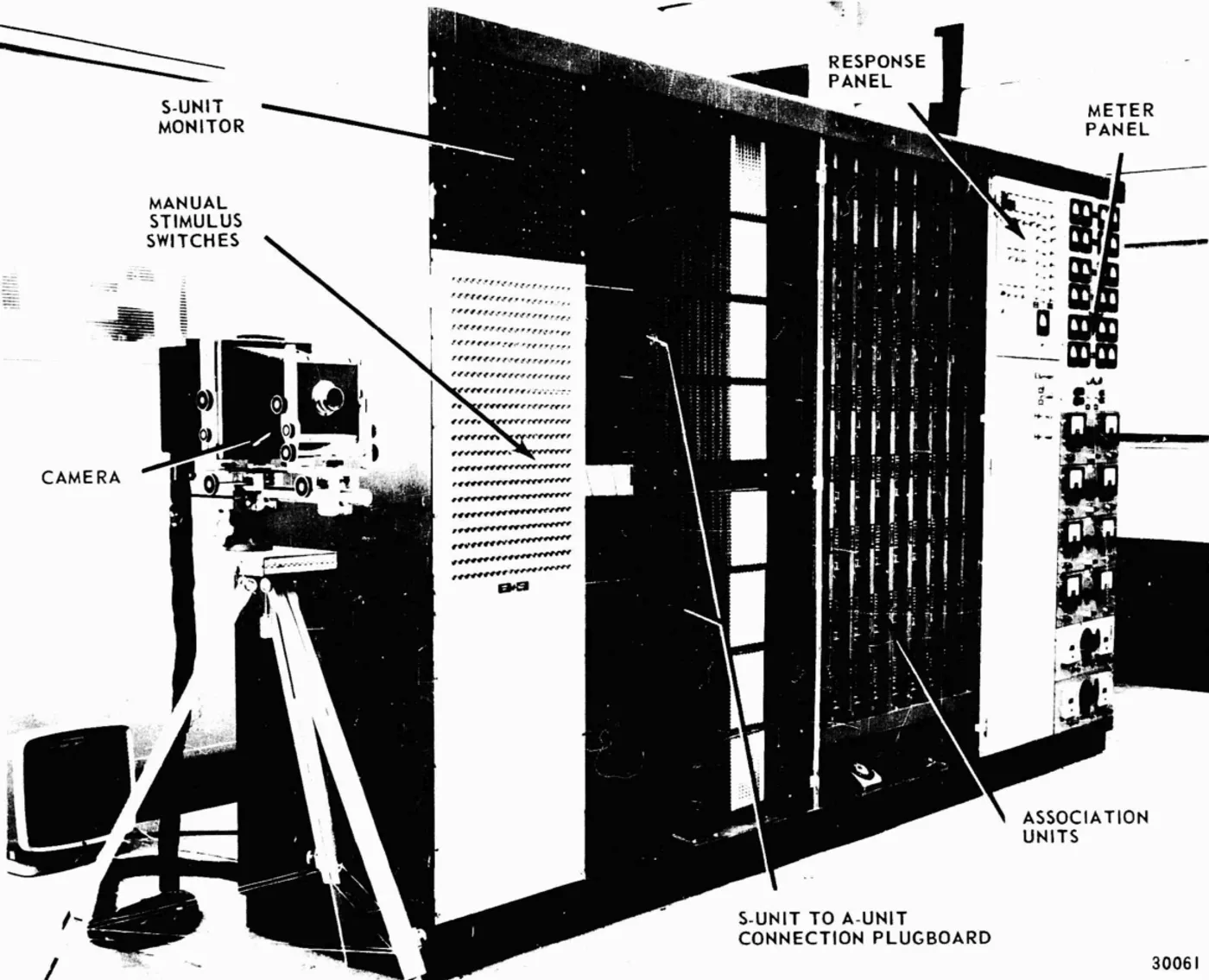
Figure 2 of the Mark I perceptron operators' manual (Hay and Murray, 1960): the machine's response units, whose weights were set by motor-driven potentiometers. Public domain. Hay and Murray, Mark I Perceptron Operators' Manual (Project PARA), 1960, via Wikimedia Commons. authentic · Hay and Murray, Mark I Perceptron Operators' Manual (Project PARA), 1960, via Wikimedia Commons · public domain in the United States (17 U.S.C. § 105; Wikimedia Commons PD-USGov) · source
From the archive
Claims in this chapter
The Mark I perceptron set its weights with motor-driven potentiometers.
verified · Mark I Perceptron Operators' Manual (Hay and Murray, Cornell Aeronautical Laboratory, 1960)